
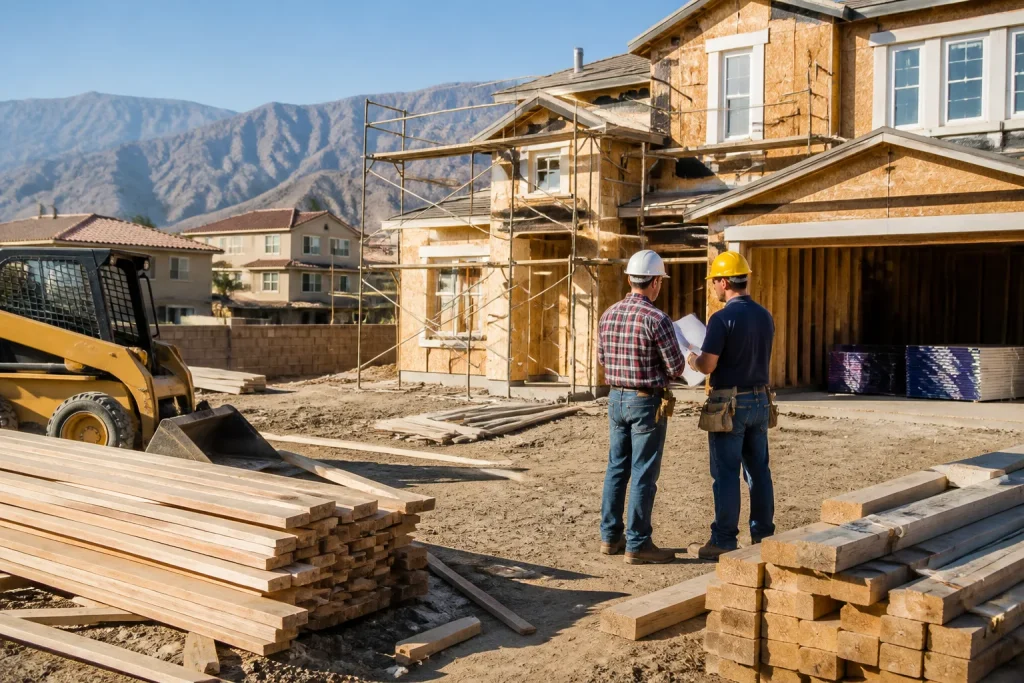
General Contractor What It Really Costs: What San Bernardino Homeowners Pay in 2026
In 2026, a general contractor in San Bernardino typically charges $85 to $160 per hour or 15% to 25% of total project cost, which means a mid-size kitchen remodel runs $65,000 to $110,000, a bathroom addition lands between $55,000 and $90,000, and a new ADU starts around $180,000 before finish upgrades. Those are loaded numbers: materials, labor, permits, design time, and the GC’s margin all baked in. The “10-20% markup” figure you’ll read everywhere was calculated on pre-2022 material costs, and in San Bernardino right now, homeowners who budget to the old benchmarks routinely come up $15,000 to $30,000 short. If you’d rather skip the math and talk scope with someone who builds here every week, call (855) 382-3257.
Key takeaways:
– GC fees in San Bernardino run 15-25% of construction cost in most bid structures
– Kitchen remodels average $65k-$110k, ADUs start near $180k, bathroom additions $55k-$90k
– San Bernardino County permit fees, Title 24 energy code, and hillside soils reports add $8,000-$25,000 many guides omit
– The fee structure (cost-plus vs. flat fee vs. percentage) changes who carries risk, and cost-plus with a guaranteed maximum is what we recommend for most mid-size projects here
What a General Contractor Actually Costs in San Bernardino Right Now
The short answer: expect to pay 15% to 25% of total construction cost for a licensed general contractor’s fee in San Bernardino. That’s not greedy. That’s overhead, supervision, scheduling, liability insurance, and the person who answers the phone when the tile installer doesn’t show.
Here’s what that looks like on five common project types in San Bernardino:
- Kitchen remodel (full gut, 200-250 sq ft): $65,000-$110,000 total, with $3,000-$8,000 in design and engineering time before you ever swing a hammer
- Bathroom addition (new 60-80 sq ft): $55,000-$90,000, driven largely by sewer line runs and foundation tie-ins
- ADU build (600-800 sq ft detached): $180,000-$320,000 including site prep, utility trenching, and Title 24 solar-readiness requirements
- Exterior package (roof + windows + siding): $45,000-$95,000 depending on roofline complexity and whether you’re in a hillside wind zone
- Hardscape + fence combo (800-1,200 sq ft paver patio with 150-200 linear feet of fencing): $30,000-$60,000, with grading and drainage eating 10-15% before the first paver goes down
One thing we’ve learned from serving as a general contractor in San Bernardino: the spreads in those numbers aren’t fluff. They reflect what’s under your floor, inside your walls, and in your soil report. We pulled a proposal out of a home near Cal State San Bernardino last fall where the homeowner had budgeted $70,000 for a kitchen based on a 2021 national guide. The actual build came in at $94,000, and $11,000 of that gap was county fees, energy upgrades, and freight cost on cabinets that had to come through the ports of LA and Long Beach.
How GCs Structure Their Fee, and Which Model Protects You
San Bernardino general contractors generally use one of three pricing models. Each one shifts risk in a different direction, and the wrong model on a mid-size job will cost you more than any material upgrade.
Cost-plus with a guaranteed maximum (our recommendation for most San Bernardino projects over $30,000): You pay the contractor’s actual cost for labor and materials plus an agreed percentage, and the GC caps the total at a written ceiling. This keeps the GC honest because they can’t pad material prices and pocket the difference, and it keeps you protected because the total can’t run away. The downside: you need to see actual receipts, and you should ask for them monthly.
Flat fee or fixed bid: The GC gives you one number for everything. Sounds clean, but here’s what happens: a fixed bid is only as good as the scope document behind it. If your bid says “install cabinets” but not “install KraftMaid cabinets with soft-close hinges and dovetail drawers,” the GC is holding a number based on the cheapest stock box they can buy. Then selections happen, and the change orders start. Fixed bids work when the plans and finish schedule are locked before you sign.
Percentage of construction cost (10-20% on top of everything): This is the old-school model. The problem in San Bernardino is that it incentivizes the GC to let costs drift upward because their fee rises with every extra thousand you spend. If you go this route, demand a not-to-exceed clause in writing.
For a mid-size project, like a home remodeling job in San Bernardino that touches two or three rooms, cost-plus with a guaranteed max is the structure we tell friends to ask for. It aligns incentives without asking you to become a forensic accountant.
The San Bernardino Cost Factors National Guides Miss Entirely
National cost guides are fine for ballparking. They’re useless for budgeting a build in San Bernardino County, and here’s why.
County permit fees run higher than most of Southern California’s inland counties. A kitchen remodel with structural changes in unincorporated San Bernardino County can carry $3,500-$7,000 in permit and plan-check fees alone, and the city of San Bernardino adds its own layer. That number lands before you pay for engineering or Title 24 documentation.
Title 24 energy compliance is not optional, and it’s not cheap. Any addition or ADU in San Bernardino must meet current California energy code, which means high-efficiency windows, insulation minimums, and often solar-readiness panels or a heat-pump water heater. Plan on $4,000-$12,000 in energy compliance costs on an ADU, and $2,000-$5,000 on a room addition. A 2019 budget won’t cover a 2026 Title 24 reality.
Hillside soils reports. San Bernardino’s northern neighborhoods, along with Crestline, Lake Arrowhead-adjacent zones, and parts of Lytle Creek, require a geotechnical soils report before you can pull permits for an addition or ADU. That report runs $2,500-$6,000. If it comes back with expansive soil (common in the foothills), foundation engineering changes, and your concrete cost can climb 20-30%.
The freight premium. San Bernardino sits 60 miles inland from the ports where most building materials enter the country. Every pallet of tile, every sheet of drywall, every window unit that comes off a ship in Long Beach pays a trucking fee to get here. That’s true everywhere, but the IE gets dinged harder than coastal cities because of the deadhead miles back to the port. On a full home renovation, inland freight quietly adds $3,000-$8,000. It’s just baked into the bid.
What Legitimate Allowances Look Like vs. the Lowball Trick
An allowance is a dollar amount the GC sets aside in your bid for a category of materials you haven’t picked yet. Lighting, plumbing fixtures, countertops, flooring. Allowances themselves are normal. The number attached to them is where San Bernardino homeowners get burned.
A legitimate allowance reflects real local pricing. In San Bernardino in 2026, that means a plumbing fixture allowance of $4,000-$7,000 for a full bathroom, a lighting allowance of $1,500-$3,500 for a kitchen, and a countertop allowance of $6,000-$12,000 if you’re specifying quartz. We install Cambria and Caesarstone countertops regularly, and those brands start around $75-$120 per square foot installed. If a bid shows a $2,000 countertop allowance for a kitchen with 45 square feet of counter, the GC knows you’re not getting Cambria. They’re planning to hand you a laminate sheet and a change order.
The lowball allowance pattern looks like this: every finish category comes in at 40-60% of what a real product costs, the bottom line looks $20,000 cheaper than the honest bid, and then “selections” happen and the change orders roll in. By the time you’re done, the lowball bid costs more than the honest one did on day one.
Ask every GC you interview the same question: “Show me a recent invoice for a kitchen similar to mine and tell me what the allowances were.” A good contractor answers without blinking. The one who deflects is telling you something.
How to Compare Two San Bernardino GC Bids That Look Nothing Alike
Line up two bids side by side and they’ll look like they were written for different houses. Different categories, different allowances, different dollar figures in different places. Here’s the normalization method we use when someone brings us a competitor bid to compare.
Step 1: Build a line-item scope list. Write down every category your project touches: demolition, rough framing, rough plumbing, rough electrical, drywall, paint, flooring, cabinetry, countertops, fixtures, windows, roofing, HVAC rough-in, finish carpentry, permits, design, and contingencies. Then list them all, every time, for every bid.
Step 2: Drop each GC’s numbers into your categories. Ignore their categories. If they lumped “cabinetry + countertops + fixtures” into one line, ask them to break it out. If they won’t, that’s a red flag, not a formatting choice.
Step 3: Mark every allowance and list it as an allowance, not a hard number. Now compare allowance to allowance. One bid shows a $9,000 countertop allowance and the other shows $3,000. That’s not a $6,000 savings. That’s a $6,000 change order waiting in week six.
Step 4: Have each GC walk your house and point at where their bid touches reality. A bid that never set foot in your crawlspace is a guess. We won’t price a San Bernardino renovation without seeing the foundation, the panel, and the attic. If a GC prices from photos, ask them what they can’t see. There’s always something.
When to Call a Pro (and When Not To)
You don’t need a general contractor to swap a faucet or hang a ceiling fan. You do need one when the project touches structure, plumbing, electrical, or the weather seal of your house. That’s the line.
The moment you’re pulling a kitchen down to studs, adding square footage, changing rooflines, relocating a bathroom, or building an ADU, you’re in GC territory. You’re also in permit territory, and San Bernardino County doesn’t issue permits to homeowners for work that requires licensed trade sign-offs. The county will tell you that when you call them. Better to hear it from us first.
One more thing: if your project spans inside and out, a kitchen plus a roof plus new windows, you want one contractor accountable for the whole scope. We’re a full-scope GC, one contract, one point of accountability, and we bring the brand partnerships to prove it. We install GAF and CertainTeed roofing systems, KraftMaid and Wellborn cabinetry, and we build through Abodu and Plant Prefab on ADU projects. That’s not a brag. It’s the reason you don’t have to coordinate three different crews from three different companies with three different schedules.
For a deeper look at how the full scope works, see our home renovation services in San Bernardino. Or just call us and ask. The conversation is free.
The Bottom Line
General contractor costs in San Bernardino in 2026 are running 15-25% of total construction cost for the GC’s fee, with kitchen remodels at $65k-$110k, bathroom additions at $55k-$90k, ADUs starting near $180k, and exterior packages between $45k and $95k. County permits, Title 24 energy mandates, hillside soils reports, and the inland freight premium add $8,000-$25,000 on top of what a national cost guide shows. The honest bids account for those numbers; the lowball bids hide them in thin allowances and wait for change orders.
If you’re in San Bernardino and need help pricing a project, Toolbox Contractors home base covers the whole county, and we offer free estimates. Call (855) 382-3257 for a number that reflects what your house actually needs, not a national average wearing a local costume.
Frequently Asked Questions
How much does a general contractor charge per hour in San Bernardino?
Most licensed general contractors in San Bernardino bill $85 to $160 per hour for small jobs and change-order work, but most projects are bid as a total scope, not hourly. On a project over $10,000, expect to see a percentage or fixed fee rather than an hourly rate. Call (855) 382-3257 for specifics on your project.
What does a $100,000 renovation actually buy in San Bernardino?
A $100,000 renovation budget in San Bernardino typically covers a full kitchen remodel with mid-to-premium finishes, or a bathroom addition with some structural work, or a roof-plus-windows package on a standard single-story. It won’t cover a detached ADU. The exact split depends on your foundation, your panel capacity, and your finish selections.
Will the price change once a San Bernardino GC starts work?
It depends on the contract structure. A cost-plus contract with a guaranteed maximum should not exceed the ceiling without a written change order you approve. A flat bid can change if the scope document is thin and your selections drive upgrades. Ask for allowances in writing and a not-to-exceed clause before you sign anything.
Do I need a soils report for an addition in San Bernardino?
In hillside and foothill zones across San Bernardino County, yes. A geotechnical soils report runs $2,500-$6,000 and is required before structural permits on most additions and ADUs in areas like Crestline, parts of Lytle Creek, and the northern neighborhoods near the mountains. Flatland lots in central San Bernardino sometimes skip it, but don’t count on it.
How long does a kitchen remodel take in San Bernardino?
A full kitchen remodel in San Bernardino typically takes 8 to 14 weeks from demo to final walkthrough, assuming smooth permit turnaround and no surprise conditions behind the walls. ADUs run 6 to 12 months depending on site work and utility connections. Call (855) 382-3257 for a realistic timeline on your specific project.
Written by the team at Toolbox Contractors, serving San Bernardino since 2013.
Need Construction Help?
Call Toolbox Contractors — licensed & insured, here with fast after-hours help in Norco.
(855) 382-3257