
Last updated October 31, 2026
 Home additions & ADU
 Kitchen remodeling
 Bathroom remodeling
 Roofing
 Windows & doors
 Driveway & pavers
 Fence
Free written scope consultation - allowances, timeline, and change-order rules on paper before a single trade is scheduled
General Contractor Maintenance Checklist for San Bernardino Homeowners
The number-one call we get in San Bernardino isn’t a burst pipe or a fallen tree. It’s the aftermath of something that a $200 maintenance visit would have caught two years earlier. A homeowner in North Park notices a water stain creeping across the ceiling and discovers the roof flashing failed three summers ago. A Verdemont family opens their crawl space to find subfloor rot from a drainage issue nobody saw. This guide is built from what a working general contractor actually finds when called in for preventable damage, not what a marketing team imagines homeowners should do. You’ll learn what to check, when to check it, what it costs, and what happens when you skip it.
Styles & brands we work with
Quick Answer
A San Bernardino home maintenance checklist should be organized around one inspection in spring (after rain season, before heat) and one in fall (after Santa Ana winds, before winter). The critical items are stucco crack inspection, attic ventilation verification, drainage and gutter cleaning, roof penetration checks, HVAC filter and coil maintenance, and subfloor moisture testing in older tract homes. Most of these cost under $300 each to address when caught early, and skipping them is how $300 becomes $8,000.
Table of Contents
- The Seasonal Maintenance Calendar That Actually Works in San Bernardino
- Exterior Checklist: Stucco, Drainage, and the Santa Ana Factor
- Attic and Roof: What a GC Checks That You Won’t See From the Ground
- Plumbing and Moisture: Subfloor Checks and the Rain Events Nobody Plans For
- HVAC and Electrical: Warranty Killers and the DIY Work We Find
- Warranty and Documentation: What Voided Warranties Cost San Bernardino Homeowners
- What Each Maintenance Task Actually Costs: A Realistic Breakdown
- Common Mistakes to Avoid
- When to Call a Professional
- Frequently Asked Questions
- The Bottom Line
The Seasonal Maintenance Calendar That Actually Works in San Bernardino
San Bernardino doesn’t have four seasons in the way a Chicago or Boston homeowner understands them. We have two maintenance windows that matter, and they’re dictated by specific climate stressors. The first is late October to early December, after the Santa Ana wind season kicks up but before the heavier winter rain. The second is March through April, after rain season ends and before the summer heat settles in for five months. Everything else is optional. Everything in these two windows is not.
Here’s the calendar we recommend to homeowners throughout San Bernardino, from Arrowhead to Del Rosa to the South Pointe area:
- October through November: Inspect stucco for hairline cracks caused by wind-driven debris and temperature swings. Clean gutters and downspouts. Check all roof penetrations (vents, pipes, chimneys, skylights). Test drainage around the foundation by running a hose at each downspout for five minutes and watching where the water goes.
- November through December: Service the furnace or heat pump before the first cold snap. Check weather stripping on all exterior doors. Verify attic insulation hasn’t been displaced by wind entering through soffit vents.
- March through April: Inspect attic ventilation before summer heat arrives. Check for rodent or pest entry points widened by winter activity. Test the air conditioning system before the first 90-degree day. Look for subfloor moisture in crawl spaces after the rain season ends.
- April through May: Reseal any stucco cracks that appeared during winter rain. Inspect window and door flashing. Check exterior paint for UV damage on south and west facing walls.
The reason this calendar works is that it aligns maintenance with the stress events that actually damage San Bernardino homes: wind season, rain season, and the long inland heat that bakes roofs and attics from June through October. If you only do two inspections per year, do them in late October and late March. If you only do one, do late October.
Exterior Checklist: Stucco, Drainage, and the Santa Ana Factor
San Bernardino’s housing stock skews toward stucco-clad tract homes built between the 1950s and 1980s, with a wave of newer construction in the north end and along the 210 corridor. Stucco is a great exterior system until it isn’t. The problem in this city specifically is the combination of Santa Ana winds, intense UV exposure, and occasional heavy rain that finds every micro-crack and turns it into a water intrusion pathway.
Here’s what we check when we’re called out to a San Bernardino home for exterior maintenance:
- Hairline stucco cracks wider than 1/16 inch. These are cosmetic until they aren’t. Water gets in, expands and contracts with temperature swings, and the crack widens. In Verdemont and North Park, we see cracks that started as hairline fissures and became spalling stucco within two to three years because nobody sealed them.
- Separation where stucco meets window and door frames. This is a flashing failure waiting to happen. The caulk joint should be continuous and flexible. If it’s cracked or pulling away, water is getting behind the stucco.
- Downspout discharge locations. In San Bernardino’s older neighborhoods like Arrowhead and Meadowbrook, downspouts often discharge directly against the foundation. That’s a design flaw from the original build, and it causes slab moisture issues that show up as cupping hardwood or musty smells years later.
- Fascia board rot around the roofline. This is common on homes with original gutters that haven’t been cleaned regularly. Water overflows, saturates the fascia, and the wood begins to rot within two to three seasons.
- Soil erosion at the foundation line. After Santa Ana season, soil can pull away from the slab edge, creating a channel for water to run directly against the footing during winter rain. We like to see soil graded away from the home at a minimum of six inches of fall over ten feet.
One thing most checklists miss: San Bernardino sits in a moderate wind zone, but the Santa Ana events we get in October and November are enough to loosen roof tiles, displace flashing, and drive debris into awkward places. After a significant wind event, walk the exterior with a pair of binoculars and look at the roofline. You’re checking for lifted shingles, shifted tile, and debris accumulation at roof valleys. If anything looks off, it’s a $150 inspection call versus a $1,200 repair once water gets in.
Attic and Roof: What a GC Checks That You Won’t See From the Ground
The average home inspector spends 30 minutes in the attic. A general contractor called in for damage spends a lot longer, because we’re looking for the same things the inspector is trained to look for, plus the things previous homeowners did that inspectors don’t flag. For a deeper look at what goes wrong and how to address it, see our General Contractor Troubleshooting: Common Problems and How to Fix Them. In San Bernardino’s older housing stock especially, attics tell a story of decades of modifications, some permitted, some not.
Here’s the attic and roof checklist we run on homes in this city:
- Attic ventilation adequacy. This is the single most skipped maintenance item in San Bernardino. Attics here regularly hit 140 to 160 degrees Fahrenheit in July and August. Without adequate intake and exhaust ventilation, that heat transfers into the living space, forces the AC to work harder, and bakes the underside of the roof decking. This is why asphalt shingles in the Inland Empire fail earlier than their rated lifespan. Check that soffit vents are unblocked by insulation, and that ridge vents or turbine vents are functioning. If you can’t see daylight at the soffit vents from inside the attic, insulation has likely been blown over them during a previous energy upgrade.
- Roof penetration flashing. Every pipe boot, exhaust vent, and chimney flashing is a potential water entry point. In San Bernardino, the combination of UV exposure and wind-driven rain means rubber pipe boots crack within 8 to 10 years. Check them every fall. A cracked pipe boot is a $300 fix. The ceiling repair, insulation replacement, and mold remediation after two seasons of leaking is a $3,000 to $6,000 problem.
- Evidence of past roof repairs done by homeowners or handymen. We find silicone caulk slathered over cracked pipe boots, shingles nailed down with roofing nails that aren’t galvanized, and patches that don’t extend far enough under the existing shingle courses. These repairs fail within a year or two. If you see signs of past repair work, have a licensed contractor evaluate it. Toolbox Contractors installs GAF, CertainTeed, Owens Corning, and IKO roofing systems, and the difference between a manufacturer-backed installation and a patch job is often the difference between a 25-year roof and a 7-year roof.
- Evidence of rodent or pest activity. Rats love San Bernardino attics. Check for droppings, chewed wiring, and insulation that’s been tunneled through. Rodent damage to wiring is a fire hazard, not just a nuisance. If you find evidence, seal entry points and address the issue before it affects your home insurance.
- The roof decking itself. From inside the attic, look at the underside of the roof sheathing. Dark staining or water marks indicate past or active leaks. Soft spots indicate rot. This is especially important in older neighborhoods like Del Rosa and Arrowhead, where roof decking may be original from the 1960s and 1970s.
Plumbing and Moisture: Subfloor Checks and the Rain Events Nobody Plans For
San Bernardino gets roughly 16 inches of rain per year, which sounds modest until you remember that most of it arrives in a handful of intense events. When it rains hard here, it rains hard for 24 to 48 hours, and drainage systems that work fine during light drizzle suddenly reveal their weaknesses. For homeowners, this means the maintenance task list has to include moisture checks that sound overkill until you’ve seen what we’ve seen under floors in this city.
Here’s what to check, and when:
- Crawl space subfloor moisture after rain events. Homes with raised foundations in areas like Meadowbrook and Arrowhead are vulnerable to standing water under the home after heavy rain. Check for musty odors, warped floorboards, and visible moisture on the underside of the subfloor within two weeks after a significant rain event. Persistent subfloor moisture leads to wood rot, mold growth, and eventually structural issues. The fix can be as simple as adding a vapor barrier or improving crawl space ventilation, or as involved as regrading the lot and installing a sump pump.
- Water supply line condition in homes built before 1980. Galvanized steel supply lines corrode from the inside out and eventually restrict flow or fail entirely. If your home still has galvanized plumbing, budget for replacement before it fails. We’ve seen original 1960s galvanized in San Bernardino homes that’s so restricted, the shower flow drops to a trickle when a toilet flushes.
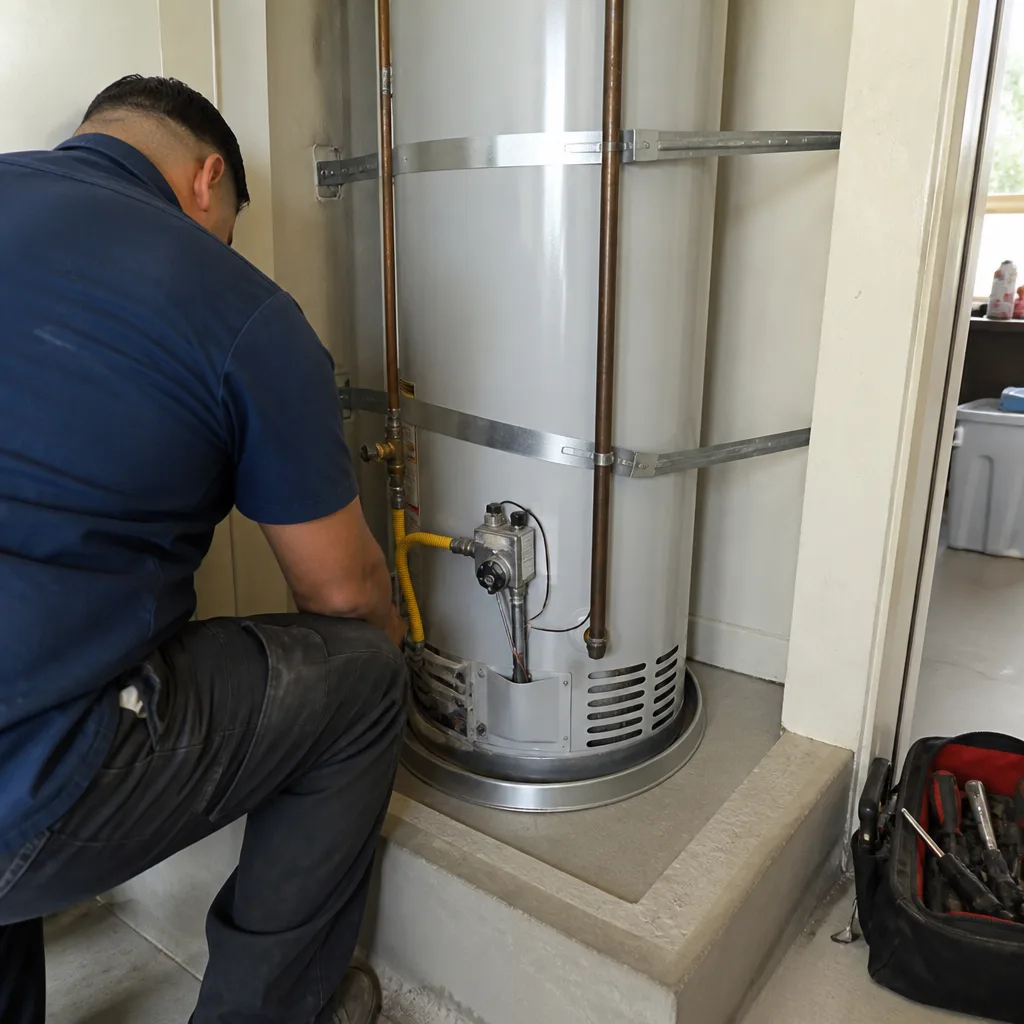
- Water heater anode rod replacement. This is a $40 part and an hour of labor. Skipping it means the tank rusts from the inside and fails in 8 to 10 years instead of 15 to 20. We recommend checking the anode rod every 3 years on San Bernardino’s hard water, which accelerates anode consumption. Most homeowners don’t know this task exists until the water heater fails.
- Angle stops and shutoff valves under sinks and toilets. These fail more often in homes with original plumbing because they’re never exercised. Turn each one off and back on once a year. If it’s frozen or leaks when moved, replace it. A $15 angle stop replacement becomes a $4,000 water damage claim when the valve fails during a toilet replacement and won’t shut off.
- Exterior hose bibs and frost protection. While San Bernardino rarely freezes, it does get cold enough in December and January to burst an uninsulated hose bib on a north-facing wall. Check that hose bibs have working shutoff valves inside the home, and that any exposed piping is insulated. This is a small task that prevents a big mess.
HVAC and Electrical: Warranty Killers and the DIY Work We Find
Maintenance checklists usually tell you to change your air filter and move on. That’s not wrong, but it’s incomplete. In San Bernardino’s hot climate, HVAC maintenance is a warranty issue as much as a comfort issue. Most manufacturer warranties on HVAC equipment require documented annual maintenance. Skip it, and the compressor that fails in year 6 of a 10-year warranty becomes an out-of-pocket $3,500 replacement instead of a covered claim.
Here’s the HVAC and electrical maintenance list that actually matters:
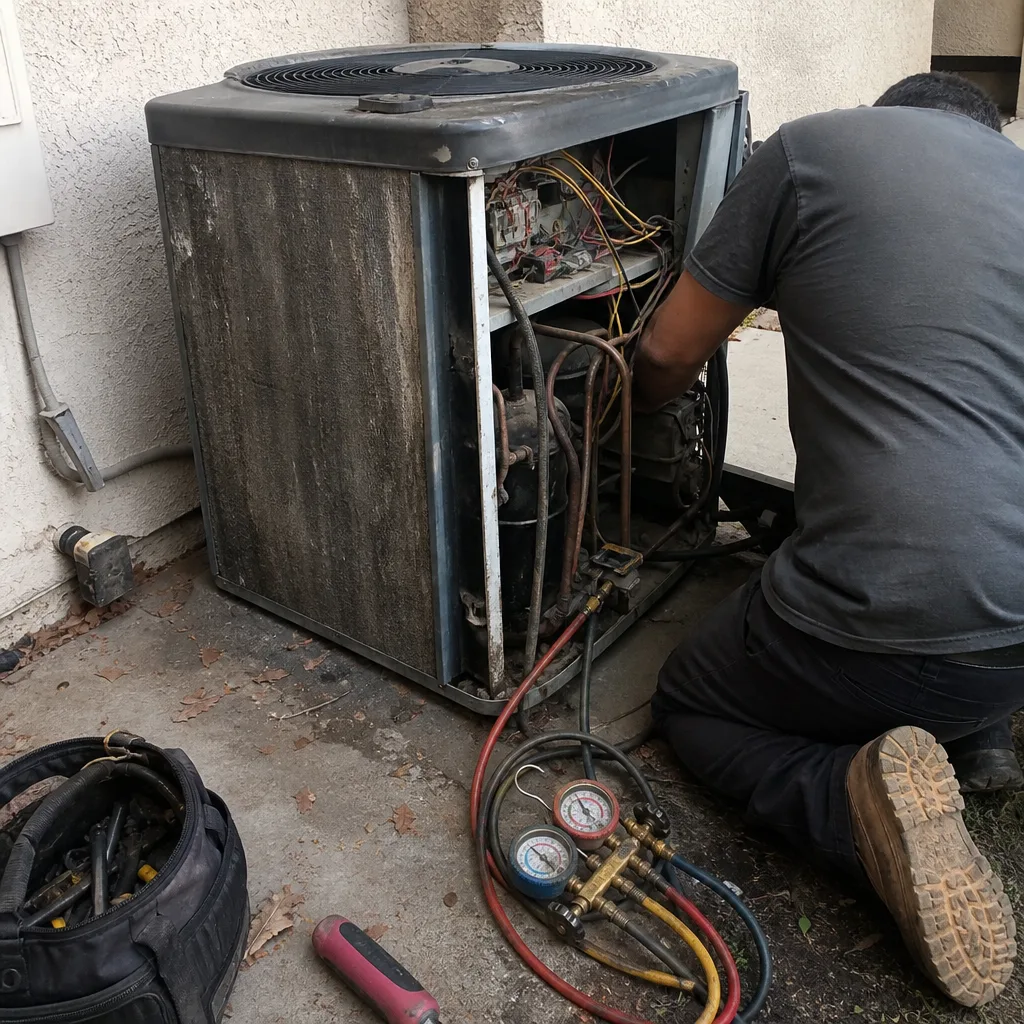
- Condenser coil cleaning in spring. The condenser unit sits outside and accumulates dust, cottonwood debris, and general Inland Empire grit. A dirty coil reduces efficiency by 20 to 30 percent and forces the compressor to work harder, shortening its life. Clean it in March or April, before cooling season starts.
- Evaporator coil and drain line inspection. This is the part of the system most San Bernardino homeowners never see, but it’s where problems compound. A clogged condensate drain line leads to water damage in the air handler closet or attic. Check it annually by pouring a cup of white vinegar down the drain line to clear algae buildup.
- Filter replacement on a schedule, not a guess. During San Bernardino’s summer, when AC runs continuously, change or clean filters every 30 days. During fall and winter, every 60 to 90 days. The exact interval depends on pets, allergies, and whether the home is near a dirt lot or construction site.
- Electrical panel inspection, especially in older homes. San Bernardino has thousands of homes with original 100-amp or 60-amp panels, and decades of DIY work layered on top. We regularly find double-tapped breakers, mixed wire gauges, and overloaded circuits in homes that have added kitchens, mini-splits, or electric vehicle chargers without upgrading the panel. A panel inspection by a licensed electrician every 5 years catches these issues before they become fire hazards.
- GFCI and AFCI verification. Ground fault and arc fault protection is code-required in kitchens, bathrooms, garages, and exterior outlets. In older homes that predate these requirements, ungrounded or unprotected circuits are common. Test GFCI outlets monthly with the built-in test button. If you have ungrounded three-prong outlets, that’s a repair we recommend addressing, not ignoring.
One note on DIY electrical: we’ve seen living room ceiling fans wired into lighting circuits with wire nuts that weren’t rated for the load, and we’ve seen under-cabinet lighting added with speaker wire. These are fire hazards. If you’re buying a San Bernardino home with visible DIY electrical work in the attic, garage, or kitchen, have it evaluated before closing or as soon as possible after.
Warranty and Documentation: What Voided Warranties Cost San Bernardino Homeowners
This section is where the biggest financial surprises live. Manufacturer warranties on roofing, HVAC, and waterproofing systems are only as good as the documentation that backs them. In San Bernardino’s active real estate market, where investor buyers and second-home purchasers are common, missing warranty documentation can cut thousands off a sale price or expose a seller to post-sale liability.
Here’s what we tell homeowners to maintain:
- Annual HVAC maintenance records. Most manufacturers require documented annual service to honor parts and compressor warranties. This is a specific requirement in the fine print, not a suggestion. If your system was installed 5 years ago and you can’t produce service records, you may have already voided a 10-year compressor warranty.
- Roof installation records and manufacturer registration. GAF, Owens Corning, and CertainTeed all offer enhanced warranties that require installer certification and project registration within a specific window after installation. If the warranty wasn’t registered, you get the base warranty instead of the enhanced coverage. Toolbox Contractors is certified to install these systems and handles the registration paperwork so the warranty isn’t voided by a missed deadline.
- Waterproofing and tile system documentation. Systems like Schluter shower waterproofing carry warranties that require proof of proper installation and use of compatible materials. Mix a different brand of thinset with a Schluter membrane and the warranty is void. Keep the product receipts and the installer’s documentation.
- Permit records for any structural, electrical, or plumbing work. San Bernardino requires permits for most work beyond cosmetic finishes. Unpermitted work doesn’t just create liability for the person who did it. It complicates future sales, insurance claims, and refinancing. We recommend maintaining a file with all permit records, inspection sign-offs, and contractor documentation for any work done on the home.
- Photos of maintenance work. Before and after photos of roof repairs, stucco sealing, and drainage improvements create a visual record that matters during resale. It’s evidence of maintenance that answers the buyer’s question: “Was this home cared for?” In San Bernardino’s investor-heavy market, that documentation contributes to stronger offers.
For homeowners planning a larger renovation, keeping these records organized before starting is also the fastest way to get accurate project pricing from a general contractor in San Bernardino. The more we know about the home’s history, the fewer unknowns we have to budget around.
What Each Maintenance Task Actually Costs: A Realistic Breakdown
Maintenance checklists often avoid pricing because pricing varies. But San Bernardino homeowners deserve realistic numbers so they can budget. Here’s what these tasks cost in this market as of 2025, based on what we and the local trades typically charge:
- Stucco crack sealing (hairline, per wall section): $150 to $400. This includes cleaning, filling, and a color-matched top coat. Larger cracks or spalling repair runs higher.
- Gutter cleaning (single-story home): $120 to $250. Two-story homes run $200 to $400. This should happen twice a year in San Bernardino because of the debris from the foothill shrubs and trees.
- Attic ventilation inspection and correction: $150 to $500 for inspection and basic fixes like clearing blocked soffit vents. Adding a solar attic fan or additional ridge vent runs $700 to $1,500.
- Roof pipe boot replacement: $250 to $450 per boot, including materials and labor. This is the single highest-ROI roof maintenance item for the money.
- HVAC annual service call: $100 to $180 for the visit and standard checks. If it includes coil cleaning or refrigerant top-off, $200 to $350.
- Water heater anode rod replacement: $150 to $250 including the part. If the rod is completely consumed and the tank shows rust, it’s time to budget for replacement.
- Subfloor moisture inspection and vapor barrier installation: $400 to $1,200 for inspection plus vapor barrier in a typical crawl space. If drainage correction is needed, costs rise based on scope.
- Electrical panel inspection: $150 to $300 for a standalone inspection by a licensed electrician. Panel replacement, if needed, runs $2,500 to $5,000 depending on amperage and accessibility.
These are planning numbers, not quotes. Homes vary, conditions vary, and scope varies. For an exact number on your home in San Bernardino, call Toolbox Contractors at (855) 382-3257 and we’ll provide a written estimate. We’re a home remodeling contractor in San Bernardino that handles maintenance, repair, and full renovation scopes, so the person who finds the issue is the person who can fix it.
Common Mistakes to Avoid
- Ignoring hairline stucco cracks because they’re “too small to matter.” Hairline cracks become structural cracks within two to three rain seasons in San Bernardino. A $200 seal job now beats a $2,500 stucco patch later.
- Skipping attic ventilation because you never go in the attic. The attic is where hidden damage compounds in this climate. Heat builds, decking warps, shingles age prematurely, and the AC works harder. Check it twice a year.
- Assuming your HVAC warranty is active without documentation. Most manufacturers require annual service records. No records, no coverage. This is the most expensive paperwork mistake in home maintenance.
- Cleaning gutters only when you see overflow. By the time water overflows the gutter, it’s been running against the fascia and foundation for weeks. Clean gutters on a schedule, not on demand.
- Ignoring the crawl space until you smell must. A musty smell means mold and rot are already present. Subfloor moisture checks should happen proactively, especially after rain season.
- Treating maintenance and renovation as separate worlds. Maintenance prevents renovation needs, and renovation should include maintenance upgrades. When you’re planning a kitchen remodel in San Bernardino, it’s the right time to address subfloor issues, old supply lines, and electrical deficiencies. Same for a home renovation in San Bernardino that touches multiple rooms. The order of operations matters.
- Buying a home without a maintenance history. In San Bernardino’s investor-heavy market, a home with no maintenance records is a risk premium. Request the documentation, or budget 10 to 15 percent of the purchase price for deferred maintenance in the first year.
When to Call a Professional
Some maintenance tasks are DIY-friendly. Others are not. The line between the two is where injuries and expensive mistakes happen. Call a professional when you see any of these: electrical work of any kind that involves opening the panel or running new wire, anything on a roof steeper than a 4:12 pitch or higher than one story, gas line connections or modifications, significant stucco cracking that suggests structural movement, subfloor rot that involves load-bearing elements, or any work that requires a permit in San Bernardino. If you’re in the city and you’re not sure whether a problem is minor or structural, hiring a construction contractor in San Bernardino starts with getting the right evaluation—Toolbox Contractors offers free estimates. Call (855) 382-3257 and we’ll tell you honestly whether it’s a maintenance item or a real project. We’d rather you call us before the water stain. It’s cheaper for you and more satisfying for us.
Frequently Asked Questions
Twice a year, once in late October after Santa Ana season and once in late March after rain season. These two windows catch the specific stressors that damage homes in this city: wind, rain, and extreme heat. If budget allows, an additional HVAC-specific service in May before cooling season is worth the $150.
A general contractor looks at the same visible systems an inspector checks, but with an eye toward causation and repair cost. We’re specifically looking for unpermitted modifications, previous repair work that isn’t holding up, drainage patterns that an inspector might note but not price, and deferred maintenance that affects the cost of future renovation. If you’re planning to renovate in San Bernardino, a GC walkthrough gives you a repair-cost perspective that a standard inspection report doesn’t.
For a typical 1,500 to 2,500 square foot home, budget $800 to $1,500 per year for the maintenance items in this guide: gutter cleaning, stucco sealing, HVAC service, roof inspection, and minor repairs. Homes that skip maintenance and need deferred repairs will spend $3,000 to $8,000 or more addressing the backlog. The math favors the annual investment.
Yes, in many cases. Manufacturer warranties from brands like GAF, Owens Corning, and IKO require installation by certified contractors and may require documentation of inspections or maintenance for the enhanced coverage to remain valid. If the roof wasn’t registered or the maintenance records don’t exist, you may be left with the base warranty, which covers far less. Call (855) 382-3257 if you’re not sure what warranty applies to your roof.
Yes, especially in homes built before 1990 and in neighborhoods with high investor turnover. Common unpermitted work includes garage conversions, room additions, bathroom remodels, and electrical panel changes. Unpermitted work affects insurance coverage, resale value, and renovation scope. If you suspect unpermitted work on a home you own or are buying, have a licensed contractor evaluate it before proceeding.
Maintenance tasks like gutter cleaning, stucco patching, painting, and HVAC filter replacement don’t require permits. But anything that modifies structure, electrical, plumbing, or roofing does require a permit in San Bernardino. When in doubt, call the city’s building department or ask a licensed contractor. We navigate permits on every project because it protects you as the homeowner. For more on what’s involved in larger scopes, see our guide on Toolbox Contractors home.
The Bottom Line
The difference between a well-maintained San Bernardino home and a money pit is two inspections a year and the willingness to spend $200 on the small thing before it becomes a $5,000 thing. This city’s climate punishes neglect: wind drives water into cracks, heat bakes roofs and attics, and occasional heavy rain exposes every drainage weakness. The checklist in this guide covers the items that actually matter to a working contractor, not a generic list of homeowner chores. Do the twice-a-year inspection, keep your documentation, fix the small stuff, and call a professional when something looks wrong. For more guides & resources on protecting your home, visit our blog. The alternative is a phone call you don’t want to make two years from now.
Written by the team at Toolbox Contractors, serving San Bernardino since 2013.
See the difference
 Before
 After
 Before
 After
 Before
 After